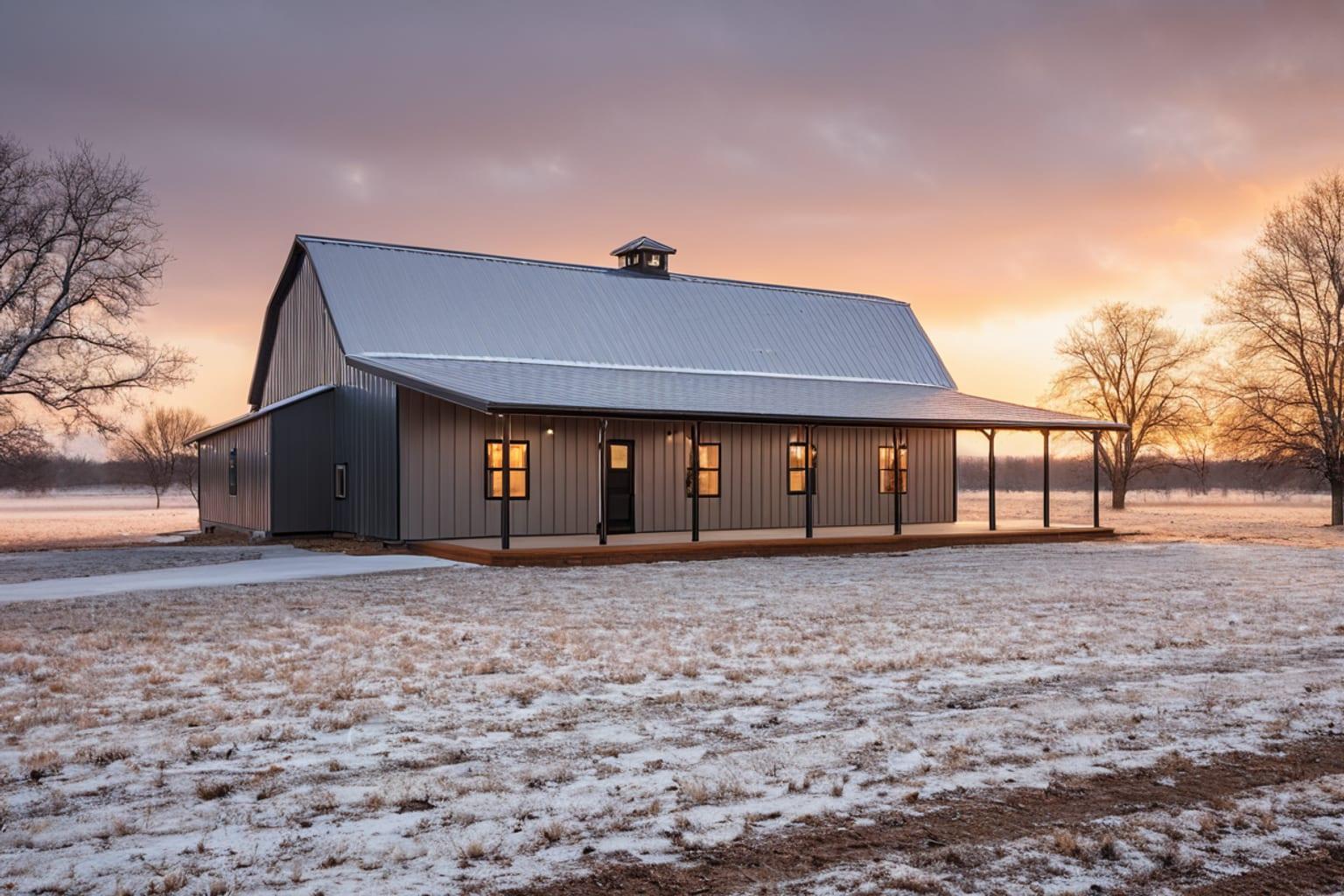
If you're an owner-builder exploring your options, you've probably encountered metal building homes (often called steel frame homes or metal barns converted to residences). They're increasingly popular among people looking for affordable, spacious alternatives to traditional construction. But are they actually a better choice than stick-built homes? The answer depends entirely on your goals, budget, and how you plan to use the space.
This guide compares the two construction methods across cost, durability, timeline, financing, and lifestyle factors. By the end, you'll know which direction makes sense for your project.
01What We Mean By Each
Stick-built homes (also called wood-frame construction) use dimensional lumber (2x4, 2x6, 2x8s) for framing, covered with sheathing, siding, and insulation. This is the standard residential construction method in North America—roughly 80% of homes built this way.
Metal building homes use steel or aluminum framing instead of wood. They're often modified versions of agricultural or commercial metal buildings, adapted for residential use. The most common residential metal buildings are 40 feet wide or wider and use a pole-frame or truss design.
The distinction matters because the two types have fundamentally different structural systems, each with real advantages and genuine drawbacks.
02Initial Cost: Where Metal Seems to Win
This is the first reason people consider metal buildings: they appear significantly cheaper.
Typical metal building pricing:
- Kit cost: $15-25 per square foot (shell only, not including interior)
- For a 1,200 sq ft metal building: $18,000-$30,000 for the kit
- Common configuration: 40' wide x 60' long metal building = 2,400 sq ft for roughly $36,000-$60,000 kit cost
Stick-built home pricing:
- Shell construction: $35-45 per square foot (varies significantly by region)
- Same 1,200 sq ft home: $42,000-$54,000 for shell construction
- Labor typically comprises 30-40% of total stick-built cost
At first glance, metal buildings look 30-40% cheaper. A 2,400 sq ft metal kit might run $36,000-$60,000, while a stick-built shell for the same square footage runs $84,000-$108,000.
But here's where it gets complicated.
03The Hidden Costs That Tip the Scale
Metal building homes look cheaper because initial kit costs are lower. But you're comparing incomplete systems.
What you're not including in that $15-25/sq ft metal building price:
- Windows and doors (add $4,000-$8,000+)
- Interior walls and partition framing ($3,000-$8,000)
- Insulation ($2,000-$6,000 for a 2,400 sq ft building)
- Roof panels and weatherproofing ($2,500-$5,000)
- HVAC and electrical rough-in ($3,500-$7,000)
- Drywall or interior finish ($4,000-$10,000)
- Foundation engineering (often more complex for wide-span buildings)
Once you add these components to a metal building, you're at $35-45 per square foot—the same as stick-built. But you've added significant complexity.
Metal building disadvantages in final cost:
-
Foundation complexity: Metal buildings exert different load patterns than stick-built. A 40-foot wide metal building creates concentrated loads at each pole. Many contractors unfamiliar with metal buildings over-engineer foundations, adding $2,000-$5,000 to costs.
-
Interior partition walls: Metal buildings have wide-open shells. Adding interior walls (bedrooms, bathrooms, offices) requires interior framing, insulation, and finishing. Stick-built homes have this structure included.
-
Electrical and HVAC routing: The open span of metal buildings creates challenges for running electrical and HVAC. You can't simply run wiring through wall cavities—you need conduit systems or surface-mounted options. Add $1,500-$3,500.
-
Insulation efficiency: Metal conducts heat and cold. Effective insulation in metal buildings requires careful attention—typically spray foam ($3,000-$8,000) or thick blanket insulation with vapor barriers. Standard stick-built batts are cheaper.
-
Drywall and finishing: The wide-open interior requires more drywall to create functional rooms. A 2,400 sq ft metal building shell might require 3,500-4,000 square feet of drywall to partition into usable rooms.
Realistic final cost comparison:
- Metal building home: $45,000 kit + $55,000-$75,000 additional materials/labor = $100,000-$120,000
- Stick-built home (same square footage): $84,000-$108,000 shell, then similar finishing costs
In other words, they often end up nearly identical in total cost once fully completed. Sometimes metal buildings actually cost more because of these hidden complexities.
The exception: if you're building an open-concept space (a workshop with living quarters, a large open studio, or an agricultural use space), metal buildings remain significantly cheaper because you're not adding extensive interior partitions.
04Durability and Maintenance: Where Metal Actually Wins
This is where the conversation shifts in metal building's favor.
Steel frame durability:
- No rot or termite damage possible
- No moisture-related framing degradation
- Lifespan: 50+ years with proper maintenance (potentially 100+ years)
- Requires paint maintenance every 10-15 years to prevent rust
Stick-built durability:
- Subject to wood rot, termite damage, and moisture issues
- Typical lifespan: 50-75 years, but can be much longer with maintenance
- More susceptible to environmental damage
- Requires regular inspection and maintenance
For metal buildings, the primary maintenance is repainting the exterior to prevent rust. A 2,400 sq ft metal building might require $2,000-$3,500 for repainting every 15 years. That's manageable.
Stick-built homes can develop serious issues—rot in plate framing, termite damage in structural members—that cost tens of thousands to repair. The key difference: metal buildings' problems are purely cosmetic (rust/paint). Stick-built problems can be structural.
Winner for durability: Metal buildings, especially in humid climates or areas with moisture challenges.
05Construction Timeline
Metal buildings offer a speed advantage, but not as much as marketing suggests.
Stick-built timeline (from foundation to weathertight):
- Foundation: 2-3 weeks
- Framing: 3-4 weeks
- Roof sheathing: 1 week
- Weathertight shell: 6-8 weeks total
Metal building timeline:
- Foundation: 2-3 weeks (possibly longer if complex)
- Erection: 1-2 weeks (the kits go up fast)
- Roof panels/weathertight: 1 week
- Shell complete: 4-6 weeks total
The metal building shell does erect faster—sometimes dramatically. A large metal building can be under roof in days. But you're now comparing 4-6 weeks vs. 6-8 weeks for shell completion. The timeline advantage exists but isn't transformative.
Where timeline really diverges is in finishing. Metal buildings require more custom interior work, which can actually extend timelines. You're not just doing drywall; you're adding interior framing, then drywall, then finishing.
Real-world comparison: Many metal building projects take just as long overall because the interior finishing complexity offsets the fast shell erection.
06Financing and Appraisal Challenges
Here's a serious consideration that catches many metal building homeowners by surprise.
Financing metal homes is harder:
- Conventional lenders are cautious about metal frame construction for residential use
- Many won't finance metal homes at all; those who do charge 0.5-1.5% higher interest rates
- FHA loans rarely approve metal frame homes
- VA loans are restrictive about metal construction
A conventional stick-built home might finance at 6.5% on a 30-year mortgage. The same metal home might require 7.0-7.5%. On a $200,000 loan, that difference costs you $50,000-$100,000+ in interest over 30 years.
Why the reluctance?
- Lenders view metal buildings as riskier (higher default rates on agricultural/commercial metal buildings skew their data)
- Appraisers struggle to compare metal homes to traditional comps
- Resale is genuinely harder for metal homes
Appraisal reality: Metal homes often appraise 10-20% lower than equivalent stick-built homes. A $250,000 metal home might appraise at $210,000-$225,000 because there are fewer comparable sales and perceived resale challenges.
This appraisal gap is one of the most overlooked costs of metal home building. If you can't finance at a good rate and the home appraises low, you're actually paying a significant premium, not saving money.
Exception: If you're paying all-cash, appraisal issues don't matter. All-cash metal building projects remain significantly cheaper than stick-built.
07Resale and Market Acceptance
Here's the uncomfortable truth many metal home owners discover.
Market perception of metal homes:
- Many buyers associate metal buildings with agricultural use, not residential
- Resale pool is smaller—fewer buyers actively seeking metal homes
- Homes often sell 10-20% below stick-built comps in the same area
- Sale timelines are typically longer (60-90 days vs. 30-45 days for stick-built)
Stick-built homes have broad market acceptance. Buyers understand them, lenders understand them, appraisers know how to value them. Metal homes remain a niche product.
This matters enormously if you might sell in 5-10 years. You could build a beautiful, well-maintained metal home for $200,000 and find it's only worth $160,000-$170,000 when you try to sell.
Exception: If you're building to stay permanently or your metal building is distinctive enough to appeal to a niche market (luxury metal home, high-end barndominium conversion), resale concerns diminish.
08The Hybrid Approach: Barndominiums and Metal Home Conversions
The rising popularity of barndominiums represents a middle ground that addresses some metal building drawbacks.
A barndominium typically combines:
- Large open metal or post-frame building
- Premium interior finishing that justifies the non-traditional exterior
- Significant acreage (rural property)
- Uses the space for multiple purposes (partial workshop, storage, plus living quarters)
This positioning changes the resale dynamic. A 3,000 sq ft metal building on 20 acres that's positioned as a luxury barndominium with premium finishes can command much better resale value than a metal "house" in a suburban setting.
For more on this option, see what is a barndominium and barndominium vs traditional home cost comparison.
09Interior Design and Modifications
Stick-built advantages:
- Room configurations are set; changes require moving framed walls
- But modifications are well-understood and routine
- Adding interior walls is straightforward carpentry
Metal building advantages:
- Wide-open space allows flexible interior configurations
- You can completely reconfigure the interior without hitting structural columns
- Large open areas (for workshops, studios, etc.) are natural
Metal building disadvantages:
- Those wide-open spaces require interior columns or posts for support
- Interior columns interrupt usable space
- Removing interior walls in a metal building is complex and requires engineering
If you know exactly how you want your interior configured before building, this difference is academic. If you think you might want to change things later, stick-built is more flexible for modest renovations.
10Environmental and Weather Performance
Metal buildings:
- Excellent in high-wind areas (steel frames are stronger than wood)
- Susceptible to condensation and moisture issues if insulation not properly installed
- Metal conducts heat efficiently—both into and out of the structure
- Excellent in areas with heavy snow loads (load capacity is very high)
Stick-built homes:
- Standard residential code compliance for most wind/snow areas
- More intuitive moisture management (wood naturally regulates humidity)
- Thermal performance depends on insulation quality (equivalent to metal when properly installed)
- Better natural humidity regulation
In extreme weather areas (high winds, heavy snow), metal buildings offer structural advantages. In areas with humidity challenges, stick-built is often easier to get right.
11The Decision Framework
Choose a metal building home if:
- You're paying all-cash (financing challenges don't apply)
- You're building on rural acreage (and considering barndominium positioning)
- You want a large open space (workshop + living, studio, etc.)
- You prioritize durability over traditional market appeal
- You plan to keep the property permanently
- You're in a high-wind or heavy-snow area
Stick-built is better if:
- You're financing the project
- You might sell in the next 10-15 years
- You want broad market acceptance and easier resale
- You want maximum interior flexibility
- You prefer traditional aesthetic appeal
- You want straightforward financing and appraisal processes
12Steel Frame Homes and Sheds
A middle-ground option gaining traction: modern steel frame homes that use engineered steel but are designed and finished like traditional homes. These are different from metal building conversions—they're purpose-built residential steel frame homes.
Advantages of steel frame homes (when purpose-built):
- No structural wood (rot/termite immune)
- More conventional interior design
- Better market acceptance than metal building conversions
- Still easier to finance than repurposed agricultural buildings
Disadvantages:
- Higher cost than metal building kits ($30-40 per sq ft for components)
- Still face appraisal and financing challenges
- Less availability in most markets
If you like metal construction but want something closer to conventional home design, purpose-built steel frame homes are worth exploring.
13The Cost Reality Check
Most owner-builders choose metal buildings hoping to save 30-40%. The actual savings typically end up being:
- All-cash project: 15-25% savings vs. stick-built
- Financed project: Little to no savings once financing costs are factored in
- Some projects: Metal actually costs more due to complexity
The real value proposition for metal buildings is durability, large open spans, and longevity—not immediate cost savings. If you build a metal home assuming it'll be 30% cheaper, you'll be disappointed.
14Construction Difficulty and DIY Potential
Metal building erection:
- Frame assembly is straightforward (follow manufacturer instructions)
- Good for owner-builder projects
- Less skill required than conventional framing
- Faster than stick-building the frame
Interior finishing:
- Adding interior walls, partitions, and finishing is the same as stick-built
- Electrical and HVAC routing is more complex than stick-built
- No inherent advantage over stick-built for DIY work
Metal building kit erection can be a good DIY project if you have basic carpentry skills and help. But the overall project isn't necessarily easier—you're just moving the complexity from frame assembly to interior finishing.
15The Bottom Line
Metal building homes aren't categorically better or worse than stick-built—they're fundamentally different, with distinct tradeoffs:
Metal wins on: Durability, large open spaces, extreme weather performance, and potential long-term maintenance costs.
Stick-built wins on: Financing, resale value, market acceptance, appraisals, and interior flexibility.
If you're building to stay permanently, paying cash, and valuing durability over conventional aesthetics, metal buildings offer genuine advantages. If you might sell, financing the project, or prioritizing broad market appeal, stick-built remains the safer choice.
For owner-builders specifically, the metal vs. stick decision isn't about the construction method being easier or cheaper in any absolute sense—it's about matching the right structure type to your specific goals, budget, and timeline.
Choose based on your actual priorities, not on assumptions about cost or difficulty. That's how you end up with a structure you're genuinely satisfied with.
Explore shouse plans for hybrid structures, or barndominium plans for metal building conversions that combine the benefits of both approaches.